
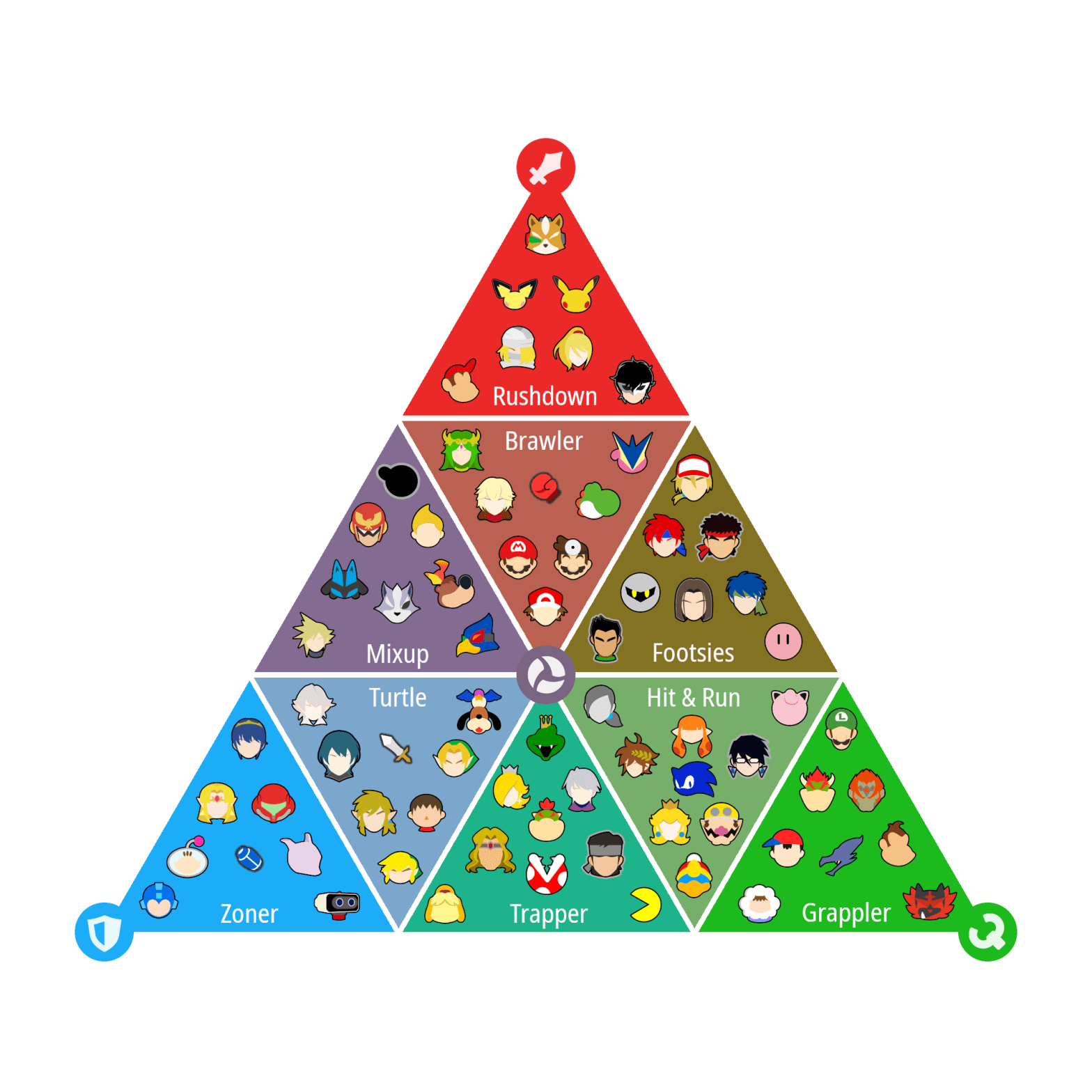
When Ultimate first launched, u/SubtleTypos on Reddit created this chart as a loose guideline to help new players figure out where each character falls regarding core gameplay archetype. Though its creator clearly stated “these are my personal views on the character and you can easily debate who falls where”, the chart quickly spread and led to a lot of debate regarding both the placement of each character and the organization of the chart itself.

One of the most common criticisms I’ve seen is that it’s not a proper ternary plot (presumably the intention); what constitutes a character being inside or outside the triangle doesn’t seem to really have any consistent pattern or reasoning, and u/PandaranQ made their own version that actually kept all characters inside the triangle. I much preferred this core concept, but felt it added too many subcategories, many of which had no real distinct meaning – what constitutes a trickster as opposed to a setup character? – so I wanted to make a simplified version, taking the best of both.
For the most part, I very much liked u/SubtleTypos‘s categories, I just felt they needed to be better organized. Read the “determine your playstyle” section on their full post for explanations of what each category means, mine are largely the same. The following is his summary:
For the sake of simplicity, let’s break down the characters into three different categories: rushdown, zoning, and bait and punish.
- Rushdown refers to characters that apply pressure at a relatively close distance, utilizing fast, lagless moves to force the opponent into a less than favorable position.
- Zoning refers to characters who apply pressure from a set distance, preferring fat disjoints or a projectile-heavy game to limit an opponent’s options. It relies on controlling an opponent’s available space and limiting their options at a distance.
- Bait and punish characters lack strong approach options and rely on finding openings to open up a heavy punish, either in the form of a hard hitting, high damage move/string or a high octane, hard to escape combo. They typically don’t want to open the approach and will try to find ways to apply safe, tricky pressure that comes off as unsafe but ultimately is.
Within these three major categories fall other subcategories that can further define a character’s playstyle. These subcategories are as follows:
- Zone breakers, characters capable of playing various playstyles and heavily pressuring opponents while maintaining a relatively safe approach.
- Mix-up characters have a relatively versatile moveset, often lacking the safety to properly contest opponents the way rushdowns can but are able to switch from a bait and punish/zoning playstyle to a more aggressive one.
- Footsies characters rely on their strong ground game, more often than not relying less on “low damage/high combo” but more so on their explosive power.
- Hit and Run characters have the speed and toolkit capable of rushing in, getting a few hits in, and getting out before things get sticky. They’re typically quick enough to maintain a safe distance from an opponent’s pressure and still be able to punish easy openings.
- Half-Grapplers are characters whose toolkits have a heavy emphasis on what they can get off of a grab. Smash Ultimate has no true grapplers as there’s no character whose moveset completely relies on getting one grab, so the characters who get a good amount off a grab live in this subcategory.
- Trappers have an extremely heavy projectile game, relying on “trapping” their opponents in their extensive web of projectiles, disrupting the opponent’s available space to move and making an approach all the more treacherous for the opponent.
- Turtles are heavily defensive with long range tools made to poke their opponent from afar, less so for the purpose of “trapping” an opponent but more so of building a wall simply to keep them out until the moment for the kill is presented to them.
- Dynamic characters have something unique to them that defines their playstyle and how you play them. The only two dynamic characters are Shulk, whose playstyle is reliant on which Monado is active at the moment, and Pokemon Trainer, where each Pokemon fulfills various needs.
Something that u/PandaranQ added in his version was a “true zoner” category as opposed to the original’s trapper corner, which I personally feel is worth adding. He also added a brawler category, which I think is an important archetype to mark but wasn’t in the right area – a brawler is more rushdown than bait-and-punish in my opinion – so I moved it. Finally, I scrapped the “dynamic” concept; it’s valid and I’m not saying mine is a better way to do it, I just think having a full category for two characters isn’t as organized; feel free to disagree because I think both ways are perfectly valid.
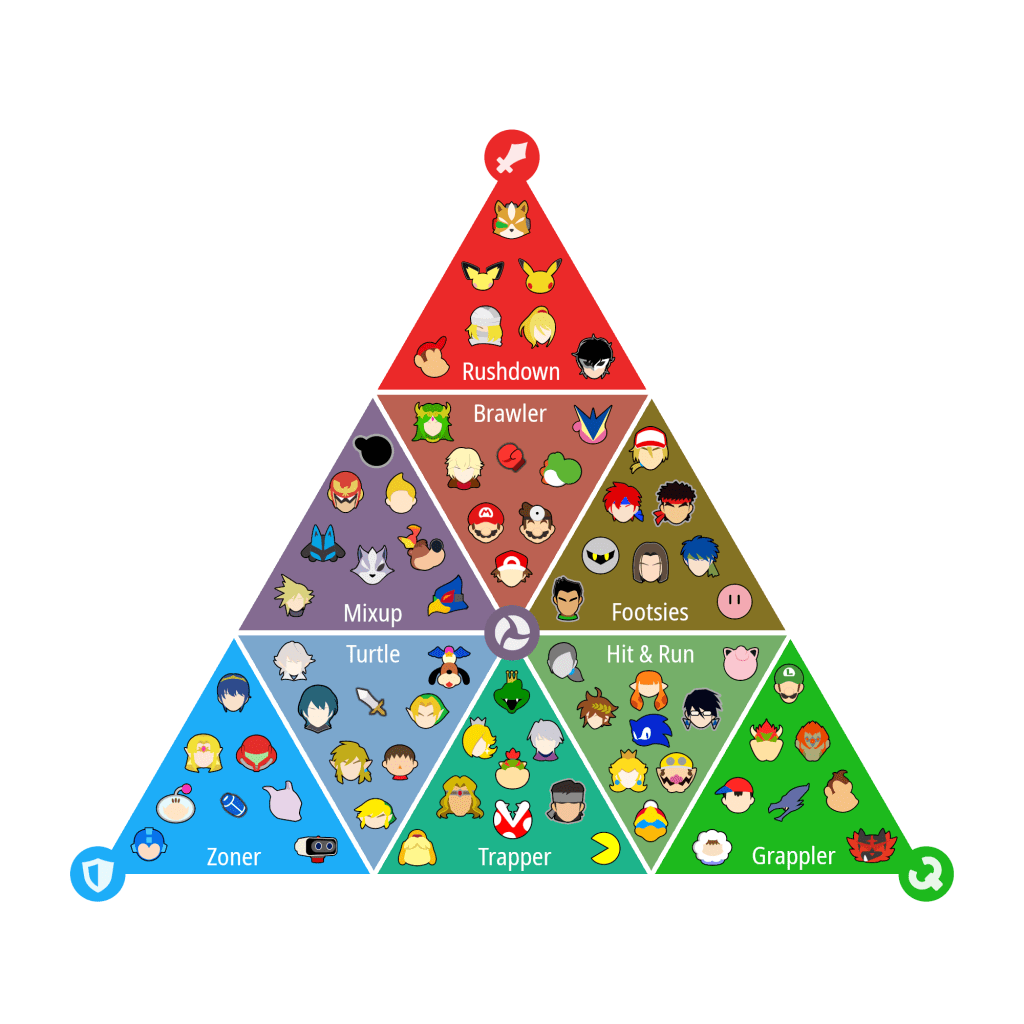
Having simple charts like this, even if they’re not perfect, helps new players because, to be frank, new players don’t want to read theory like more serious players do. Giving them a good starting point is all I want.
 Smash Labs